

My Approach
I use multiple tools to understand what's actually happening, and to build a plan around it rather than a guess.
Many protocols can be implemented without advanced testing. But measuring the right markers usually helps — to track the direction of change, confirm an intervention is actually working, or find the root cause in the first place. Symptoms are only labels; the same symptom can come from entirely different underlying causes.
Functional medicine and naturopathy work this way because they look at the body as one connected system, not a set of separate complaints. Testing and genetics show what's happening beneath the surface — and coaching often reveals just as much, since patterns often show up in daily life before they show up in a result.

Health & lifestyle coaching
Coaching fundamentally revolves around facilitating change and inspiring action.
This is deliberately the first of tools I use. Testing and a plan can tell you exactly what to do. Most people already know quite a lot of it. The harder part is actually doing it, consistently, when life gets in the way — and that gap is usually where things actually fail.
Health coaching isn't motivational chat. It draws on established behaviour-change science and motivational interviewing — recognised methods, not improvisation — applied specifically to making a health plan survive contact with real life.
Regular sessions provide structure and accountability: reviewing what's working, adjusting what isn't, and working through whatever's actually getting in the way — time, motivation, conflicting priorities, old habits that resist changing.
This isn't therapy, and it's not meant to be. It's forward-looking and practical, focused on turning a plan into a daily reality rather than exploring why old patterns formed in the first place. If something deeper surfaces along the way, that's exactly when a referral to the right professional matters more than pushing through alone.
Coaching rarely stands apart from everything else here. A nutrition or lifestyle plan, or a testing result, can tell you what to change — coaching is what turns that into a new habit, and eventually into a different identity, rather than something that fades once motivation does.

Personalised nutrition assessment & therapy
Personalised Nutrition Therapy: Your Key to Optimal Health and Longevity.
Food and supplementation (if needed) built around what your results actually show. You won't get a generic protocol, or one-size-fits-all recommendations designed for an "average person" who doesn't exist.
Two people with the same symptom can need entirely different nutrition strategies, depending on genetics, current health status, health history, goals, and what testing reveals. This is where that gets worked out.
A typical programme starts with extensive questionnaires, food diary thorough analysis and an extended initial consultation (around 90 minutes), followed by a structured series of follow-ups (or at least one). Where useful, this includes functional testing to establish a starting point and track progress, practical resources to support the process, and ongoing contact between sessions when something needs addressing before the next one.
The aim throughout is the same as everywhere else in this work: find what's actually driving things, and build something that holds.
If red flags come up along the way, a referral to your GP or another specialist is part of the process — this is an integrative approach, not a replacement for medical care.
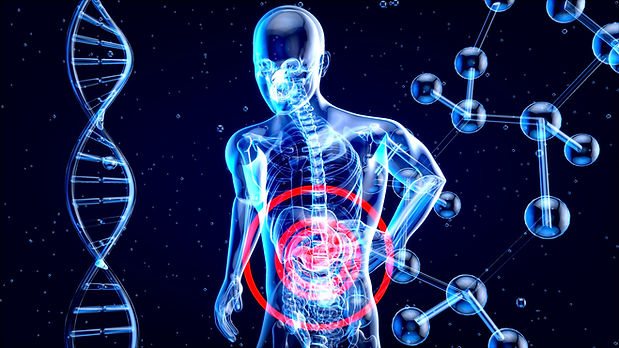
Nutrigenomics.
DNA-driven nutrition
These tests provide valuable insights into how each individual's unique genetic makeup interacts with nutrition and lifestyle factors.
Genes influence how your body handles food, exercise, stress and certain substances — but they're a tendency, shaped heavily by lifestyle, sleep, stress and environment through epigenetics. They rarely tell the whole story alone.
Some genetic variants (SNPs) create real bottlenecks in specific biological pathways — a slower step in detoxification, a higher requirement for a particular vitamin, a less efficient conversion of one nutrient into another. The body usually compensates, but compensation has a cost: a bottleneck like this can quietly increase the demand for certain foods, specific supplements, or occasionally medication, long before it shows up as a symptom.
Spotting these is what nutrigenomics is genuinely useful for: how you respond to fats, carbohydrates, proteins, specific vitamins and minerals; how your body handles caffeine, alcohol or certain compounds; and patterns relevant to nervous system function, hormonal balance, metabolic health and detoxification. Sometimes this answers questions standard lab tests simply can't.
Results get read alongside functional testing, history and current symptoms, completing the picture rather than standing apart
from it.
The test itself is simple — usually saliva or a cheek swab. The report comes after a proper conversation about what it means,
and what to do next.

Functional testing and interpretation
Multiple root causes of a health problem can lead to similar symptoms.
Different root causes can produce nearly identical symptoms. And some imbalances build quietly for years — sometimes a decade — before they're visible enough to call a diagnosis.
Standard medical testing is built to catch disease, using reference ranges designed to flag clear abnormality. That's exactly what it should do, and it does it well. Functional testing asks a different question: not "is this abnormal," but "is this optimal" — looking at how systems interact, often picking up shifts long before they'd cross into a diagnosable condition.
Both have their place. Functional testing doesn't replace a GP or specialist — it fills the gap between "your results are normal" and "you don't feel normal," which is often where the real answer is hiding.
Results are never read in isolation. They're set against other test results, family history, genetic testing and a thorough interview — the full picture matters more than any single marker.
Where possible, basic markers are tested through local, refundable routes — there's no reason to pay for what's already available. The more advanced or specialised markers typically require laboratories that focus specifically on functional medicine, in the UK and internationally. Testing is arranged accordingly, with results always reviewed and explained together, not handed over alone.

Continous glucose monitoring
Blood glucose level is one of the clearest, fastest-moving signals of metabolic health.
CGMs sit in a category of their own among the tools used here. Some versions are licensed medical devices, used under medical guidance for managing a diagnosed condition. Others are lifestyle-focused, designed simply to help someone understand their own patterns. Both matter, for different reasons — and both are genuinely useful for many clients.
A small biosensor, worn on the arm for around two weeks, shows how glucose moves throughout the day. Not a single number from a fasting blood test or a finger prick — but the actual pattern in response to specific meals, sleep, stress and movement.
This matters. How high it spikes after a meal, how quickly it settles, and how much time is spent in a healthy range say something real about insulin sensitivity, energy regulation and inflammation — long before any of that would show up on a standard annual blood panel.
Using a CGM helps build new behaviours and sharpens awareness around food, movement and stress in real time. Sometimes, the pattern it reveals is also the clue that points toward further testing — and the actual root cause underneath a metabolic issue.


